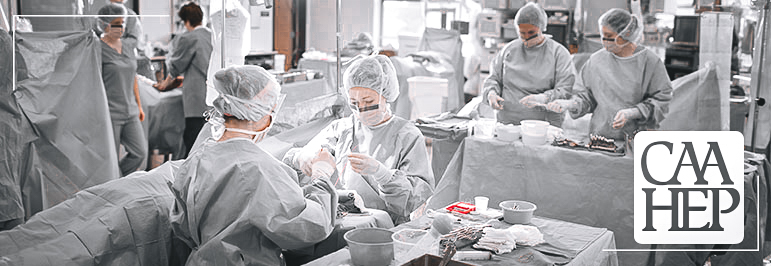
The Bellingham Technical College Surgery Technology Program is accredited by the Commission on Accreditation of Allied Health Education Programs (Http://www.caahep.org/) upon the recommendation of the Accrediting Review Council on Education in Surgical Technology and Surgical Assisting.
9355 113th St N, #7709 Seminole, FL 33775 727.210.2350
If you are interested in being a valuable part of surgery teams, working beside surgeons, nurses, and other medical professionals, you can train for an exciting career as a Surgery Technologist. With BTC’s high quality education and hands-on training, you’ll gain the valuable skills needed now by hospitals, outpatient surgery centers, and dental surgery offices.
BTC's students graduate prepared for top jobs:
100% of program graduates passed the National Certification of Surgical Technology Exam in 2010, 2011, 2013, 2014, 2015, 2016, 2017, 2019, 2020, 2021, 2022, 2023, 2025, and 2026.
91% of program graduate passed the National Certification of Surgical Technology Exam in 2024.
90% of program graduates passed the National Certification of Surgical Technology Exam in 2018.
Upon successful completion of the BTC Surgery Technology Program, students are awarded an Associates Degree in Applied Science-Transfer (AAS-T) and are eligible for registration as a Surgical Technologist in WA State.
Note: BTC has not made a determination that the Surgery Technology curriculum meets educational requirements for licensure/certification outside of Washington State. We encourage students who plan to work out-of-state to check relevant local licensure/certification requirements.
1Employment data come from the Washington State Board for Community and Technical Colleges (SBCTC) and reflect three-year averages among BTC students employed in either Washington or Oregon. Students are included in the employment rate if they left with a credential. Rates are not shown for programs with fewer than 10 students meeting the above criteria.
2Whatcom County and WA State wage data come from Washington State Employment Security Department (ESD) Occupational Employment and Wage Estimates. Wage data represent occupations that BTC faculty have identified as the most relevant career paths for program graduates. Note that these wages reflect employees with varying educational levels/credentials. For cases in which multiple occupations have been identified by faculty, a weighted percentile is calculated using each occupation’s percentile wage and employment size estimate. Wages are not shown for programs for which occupations do not meet the ESD’s minimum thresholds for publishing. If the program has wage data that involves shift work, these ESD wages reflect the same number of hours used in the annual wage calculation. Starting wage = 25th percentile, median wage = 50th percentile, wage potential = 75th percentile.
Estimated costs based on 3 quarters to complete this program The first quarter of study will likely be more expensive as students pay for materials needed to start the program.
Students interested in the Surgery Technology program should apply to the college and contact Admissions at 360.752.8345 or at admissions@btc.edu for assistance with getting started at BTC. A college application and your score on assessment testing and/or previous transcripts will determine where you begin your course sequence.
This program typically admits students into first quarter core courses in the fall. Registration for Fall Quarter starts halfway through Spring Quarter.
Program-ready students are invited to register for Surgery Technology courses. Students who have completed ALL prerequisite requirements before the start of first quarter core courses will be allowed entry based on the order in which they register.
There is no separate admission process or application for this program.
What are the Minimum Entry Requirements?
Early Program Course Requirements
Prior to registering for the program core courses students complete all General Education courses at BTC or complete the transcript evaluation process for courses taken at another institution.
ALL COURSES MUST BE A MINIMUM OF 5 QUARTER CREDITS OR 3 SEMESTER CREDITS
Completion of the following courses with a minimum grade of 2.7 (B-) or higher in each course:
Introduction to Surgery Technology (SURG 100)
Human A&P 1 (BIOL& 241)
Human A&P 2 (BIOL& 242)
Microbiology (BIOL& 260)
Introduction to Chemistry (CHEM& 121 or CHEM& 161)
Completion of the following courses with a minimum grade of 2.0 (C) or higher in each course:
General Biology with Lab (BIOL& 160)
Interpersonal Communications (CMST& 210) or General Psychology (PSYC& 100)
Fundamentals of Medical Terminology (HT 100)
Clinical Placement Requirements
AFTER admissions acceptance into the program and prior to beginning program classes, students must submit proof of all Clinical Placement Requirements. You will receive an email from the department with deadlines for completing clinical requirements, and instructions for creating an account and submitting documentation. Account creation, criminal background history and urine drug screening will cost an estimated $175.
Nursing and Allied Health students must obtain a criminal background check through Complio/American DataBank. The background check must include the following categories: State, County, and National criminal background history; sex offender registry check; Social Security Number trace; and the Office of the Inspector General ("OIG"). Some clinical partners also require students to complete a background check through the Background Check Central Unit (BCCU) for Washington State Department of Social and Health Services authorized service providers.
The College will maintain records on all students that clinical partners may use to document compliance with RCW 43.43.830-842. Criminal background check findings will be shared with clinical partners who will determine if it is satisfactory for the facility. If the results of a background check are less than satisfactory, clinical sites may deny access to that student. If clinical partners have determined criminal background check findings to be less than satisfactory, the student will not be able to complete the program of study.
Bellingham Technical College is not responsible for a student’s ineligibility for employment and/or state licensure. Washington State Department of Health does background checks prior to certifying a license. The disqualifying crimes and negative actions can be found on the Washington State Department of Social and Health Services website.
Students must provide a negative 10-panel urine drug test through Complio. Dilute urine analysis samples require rescreening within five business days at an additional cost and a second dilute sample is considered positive. You will receive an email from the department if your final drug test results are positive, and you will be ineligible to participate in the program for one year.
Notice About Marijuana Usage
Students who test positive for THC (marijuana, including prescription marijuana) will not be allowed entrance to Nursing and Allied Health programs with clinical components. Drug screening is a requirement of our clinical partner agencies. Although private recreational and medical use of marijuana is legal in Washington state, our clinical partner agencies are governed by federal laws, and marijuana is a prohibited substance at the federal level. If your final drug test results are positive, you will be ineligible to participate in the program that year and will be allowed to reapply to the program 12 months from the date of the positive test.
Students must have proof of all the required immunizations uploaded and accepted by Complio before they can attend clinical. Required immunizations include:
Students must submit proof of negative TB status to the program annually. TB screening tests are valid for one year. Most students complete the 2-step TB Skin Test (TST).
Students are required to be CPR certified. Only the American Heart Association (AHA) Basic Life Support (BLS) for Healthcare Providers (HCP) certification will be accepted. CPR certification is good for two years, and must be done in such time that it will not expire while the student is still in the program. Further information will be provided upon acceptance into the program.
You must submit proof of current health insurance coverage. Student Injury-only insurance is acceptable and information on how to enroll is available on the BTC website. Your health insurance must be current throughout the duration of the program.
You are now able to sign up for classes in ctcLink using the class list below. It requires certain steps to work smoothly. Please read and follow the instructions:
Once at the beginning of each session:
Follow the link below which will open the ctcLink login screen in a new browser tab
In the new tab login to ctcLink
Return back to this tab
These steps log you into ctcLink and keep you logged in until you log out manually or close your browser. If you or a public computer it is good security practice to logout and close all browser windows when you are done.
Click on the name of the class below to show future offerings
Click the 'Find in ctcLink' button below the class you wish to find. (Button will only show if registration is open.)
A new tab with the ctcLink Class Search tool will open
Without changing any of the filter options, click the 'Search' button
Only the specific class you selected will show. If logged in following the steps above, you will be able to register for the class.
Quarter 1
SURG 120
Surgery Technology I
12 CR
The student will gain theoretical and practical knowledge of general equipment, instrumentation, surgical team member roles and health care facilities and their management. Includes physical, psychological, and ethical aspects of patient care in addition to principles of aseptic technique, sterilization and safety in the operating room. Students will participate in activities that help to identify, manage and apply general terminology to medications and solutions used in operating room settings. Student will apply the theories and principles of pharmacology for use in the operating room environment in order to provide safe and effective management of medications.
Prerequisites: the following courses must be completed with a B- or higher: SURG 100, BIOL& 241, BIOL& 242, BIOL& 260, CHEM& 121 or CHEM& 161, ENGL& 101, and MATH& 107 or higher. The following courses must be completed with a C or higher: BIOL& 160, CMST& 210 or PSYC& 100, and HT 100.
Co-requisite: SURG 125
This class meets face-to-face for scheduled classes at specific times. There is no online instruction, although an online learning platform may be used supplementally.
SURG 125
Surgery Technology Lab I
10 CR
The student will participate in lab activities based on principles and techniques of operating room procedure. Students will develop skills necessary to plan, set-up and maintain sterile fields. In addition, the student will orient to health care facilities.
Prerequisites: the following courses must be completed with a B- or higher: SURG 100, BIOL& 241, BIOL& 242, BIOL& 260, CHEM& 121 or CHEM& 161, ENGL& 101, and MATH& 107 or higher. The following courses must be completed with a C or higher: BIOL& 160, CMST& 210 or PSYC& 100, and HT 100.
Co-requisite: SURG 120
Current & Future Offerings:
Quarter 2
SURG 133
Surgery Technology II
10 CR
In this course the student will gain further theoretical and practical knowledge of specialty equipment, instrumentation, and surgical supplies. The student will detail intra operative care techniques and the surgical technologists' role in surgical case preparation and surgical procedures. Prerequisite: SURG 120 and SURG 125, both with a C+ or higher. Co-requisite: SURG 136
This class meets face-to-face for scheduled classes at specific times. There is no online instruction, although an online learning platform may be used supplementally.
SURG 136
Surgery Technology Clinical Practice I
10 CR
The students will participate in activities that correlate the theories and principles of surgical procedure and technique in a mock operating room (lab) setting. In addition students will assume the role of a student surgical technologist participating in surgical procedures in affiliated hospitals, surgery centers or clinics. Prerequisite: SURG 120 and SURG 125, both with a C+ or higher. Co-requisite: SURG 133
Current & Future Offerings:
Quarter 3
SURG 143
Surgery Technology III
6 CR
In this course the student will gain further theoretical and practical knowledge of specialty equipment, instrumentation, and surgical supplies. The student will detail the surgical technologist's role in procedures and techniques used to achieve intraoperative hemostasis, proper patent documentation and patient care emergencies. The students will also describe the surgical technologists' professional and legal responsibilities. Prerequisite: SURG 133 and SURG 136, both with a C+ or higher. Co-requisite: SURG 145
This class meets face-to-face for scheduled classes at specific times. There is no online instruction, although an online learning platform may be used supplementally.
SURG 145
Surgery Technology Clinical Practice II
10 CR
The students will participate in activities that correlate the theories and principles of surgical procedure and technique in a mock operating room (lab) setting. In addition students will assume the role of a student surgical technologist with emphasis on independent scrubbing on surgical procedures in affiliated hospitals, surgery centers or clinics. Prerequisite: SURG 133 and SURG 136, both with a C+ or higher. Co-requisite: SURG 143
The goal of this program is to prepare entry-level Surgical Technologists who are competent in the cognitive (knowledge), psychomotor (skills), and affective (behavior) learning domains to enter the profession.
Upon completion of the Surgery Technology program, the student will be able to:
Demonstrate proficiency in the care of the operative environment preoperatively, intraoperatively, and postoperatively.
Provide safe patient care with strict adherence to sterile technique and asepsis.
Demonstrate critical thinking relating to prioritization, anticipation, problem analysis and evaluation of solutions.
Apply the principles of effective verbal, non-verbal, and written communication.
Compile completed Clinical Case Experience Log of surgical procedure assistance in accordance with the Core Curriculum for Surgery Technology, 7th ed.
Demonstrate knowledge and experience by successful completion of the National Certification Examination for Surgical Technologists.
Employment Outlook
Employment of surgical technologists is expected to increase. Technological advances such as fiber optics and laser technology will also permit new surgical procedures to be performed.
Criminal convictions may restrict or prevent student participation with internships and employment in this industry.
Most surgical technologists are employed by hospitals and work primarily in operating and delivery rooms. Others are employed in clinics and surgical centers and in the offices of physicians and dentists who perform outpatient surgery. Hospitals will continue to be the primary employer of surgical technologists, although much faster employment growth is expected in offices and clinics of physicians, including ambulatory surgical centers.
Criminal convictions may restrict or prevent student participation with internships and employment in this industry.